
Supporting Children’s Bilingual Development

Maintaining Chinese Language and Culture at Home
Importance & Benefits of Bilingualism
1. Cognitive Benefits
Maintaining your child’s heritage language and cultural practices at home is crucial for their bilingual development and overall well-being. Research has shown that bilingualism offers significant cognitive benefits, including the enhancement of cognitive abilities and brain development. Bilingualism improves skills such as problem-solving, multitasking, and creativity. It helps develop better executive control, enabling individuals to manage tasks more efficiently and switch between activities without being distracted. Moreover, bilingualism positively impacts brain structure and function. Managing more than one language increases neuroplasticity, which enhances cognitive control and flexibility.
3. Cognitive Function in Adulthood and Aging
Maintaining the heritage language strengthens cultural identity and family bonds, which ensures that children have a strong connection to their cultural roots. Bilingualism also facilitates better social integration and communication in diverse environments. This allows individuals to interact more effectively with a broader range of people and cultures.
2. Cognitive Function in Adulthood and Aging
Bilingualism can delay the onset of dementia and other cognitive declines in old age. Studies have shown that bilingual individuals tend to show symptoms of dementia later than monolingual individuals, which is attributed to the cognitive reserve built through lifelong bilingualism. The concept of cognitive reserve explains how lifelong brain training through bilingualism can protect against cognitive decline. Bilingual individuals often have a higher cognitive reserve, which helps maintain better mental functioning despite brain pathology associated with diseases like Alzheimer’s.
4. Educational Advantages
Strong skills in the heritage language can support English language learning and overall academic success. Bilingual children often perform better academically due to enhanced cognitive abilities and executive functions.
Understanding the Process
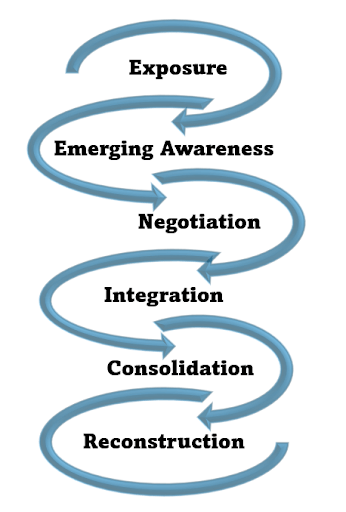
Understanding the process your children may go through while maintaining their heritage language and culture is beneficial to their success. Bilingual identity is not static; it evolves as children interact with their environments and experiences. Children constantly negotiate their sense of self in relation to both their heritage and the new culture they are adapting to. Therefore, it is important to recognize the challenges your children may face, such as balancing two languages and cultures and feeling confused at times and provide the necessary support.
Aspects to consider for maintaining heritage language and culture:
1. Children may struggle with their cultural identity as they navigate between their heritage culture and the new culture they are adapting to. It’s important to create an environment where they feel proud of their heritage while also feeling comfortable in their new surroundings.
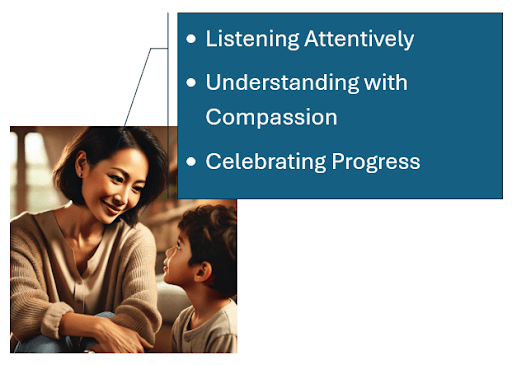
2. Language learning can be frustrating and challenging at times. Providing emotional support, understanding their struggles, and celebrating their progress can make a significant difference in their motivation and self-esteem.
3. The influence of peers can play a significant role in language use and cultural integration. Encouraging friendships with both heritage and non-heritage peers can provide a balanced social environment.
4. Active parental involvement in language learning and cultural activities can set a positive example and reinforce the importance of maintaining heritage language and culture. Parents can participate in learning activities, attend cultural events, and support their children’s efforts.
Strategies for Maintaining Language and Culture
- Encourage daily conversations in Chinese
- Engage in cultural practices, such as holidays, storytelling, and participating in community events.
- Incorporate Chinese books, movies, music, and TV shows to immerse children in the language and culture.
- Create a bilingual environment where both Chinese and English are valued.
- Enroll children in Chinese language classes or bilingual programs.

- Understand the hardships your child can encounter. Praise and encourage your child’s efforts in both languages.
- Encourage interactions with grandparents and other relatives who speak Chinese to provide more exposure and practice opportunities.
- If possible, visit heritage countries to give your child immersive experiences in the language and culture.
- Encourage your child to make friends with other bilingual children. This creates opportunities for mutual language practice and cultural exchange.
- Join local Chinese cultural organizations or community centers that offer language classes, cultural activities, and social events. Engaging with the community helps reinforce language skills and cultural pride.
Selecting Chinese and English Reading Materials

Choosing the right reading materials for your bilingual child can seem daunting. Below are some tips to guide you in selecting appropriate books to support your child’s language development, which makes their reading journey a rewarding and enriching experience!
Tips for Selecting Reading Materials
- Choose books that match your child’s current reading level in both languages. There’s no need to select materials that are way above their ability, as this can lead to frustration and disengagement. For instance, for beginner readers, picture books with repetitive phrases can be helpful, as learners can interpret concepts by looking at the pictures.
- Ensure the content is suitable for your child’s age group. Bilingual books should match their developmental stage and comprehension level.
- Ensure the text is clear and readable. The font size and type should be suitable for your child’s age group to make reading comfortable.
- Pick books that align with your child’s interests. Whether they love animals, adventures, or fairy tales, finding topics they enjoy will motivate them to read more.
- Select books that reflect both their heritage culture and the new culture. This dual exposure helps in maintaining cultural identity while adapting to a new environment.
- Choose books with high-quality translations. Poor translations can confuse children and hinder their learning process.
- Involve your child in choosing materials to make them feel invested in their reading. Discuss the story with your child to enhance comprehension and cultural understanding.
Educational Activities

Scavenger Hunt
Materials Needed:
- Post-it notes or cards for writing clues.
- A final prize.
Preparation:
- Choose an occasion, such as Lunar New Year, children’s day, or birthday.
- Prepare 4-6 clues written in Chinese. Each clue leads to the next location and eventually to a prize, such as a birthday present. For example, the prize can be a birthday present.
- Hide the clues around the house. Ensure each location is safe and easily accessible.
Steps:
- Explain the game rules to the children in Chinese.
- Hand the first clue to the children.
- Go with your children and read the clue out loud with them.
Sample Clues & Locations:
- Clue 1: 找你刷牙时用的东西 (Fine something you use when you brush teeth.)
- Location: Bathroom; the next clue is placed under your child’s toothpaste.
- Clue 2: 找你用来吃早餐的东西 (Find something you use to eat breakfast in the house.)
- Location: Kitchen drawer; the next clue is placed on top of the silverware.
- Clue 3: 去拿你最喜欢的故事书 (Go get your favorite storybook.)
- Location: Bookshelf; the next clue is placed inside the book.
- Clue 4: 找你每天穿去学校的鞋子 (Fine the pair of shoes you wear every day to school.)
- Location: Shoe cabinet; the next clue is placed inside one of the shoe that your child wears every day to school.
- Clue 5: 最后一个提示放在你睡觉的地方 (Find the last clue at the place where you sleep.)
- Location: Bedroom; the final clue is placed on your child’s bed.
- Final clue: 打开你衣柜的最底层抽屉 (Open the bottom drawer of your dresser.)
- Final Prize: Wrapped and placed in the bottom drawer of the dresser with a note that says, “恭喜!” (Congratulations!)
Story Telling Chain
This would be a good game to play during a long car ride or during dinnertime while everyone is gathering at the dining table.
Steps:
- Explain the rules in Chinese. Encourage your child to be creative and make the story fun and everyone will contribute to its development.
Sample:
- Person 1 starts the story with a sentence or two in Chinese. It can be “从前,在一个遥远的村庄里,住着一个小男孩名叫 Alex。 (Once upon a time, in a distant village, there lived a little boy named Alex.)”
- Tip: Make this relevant to your children by including their friends’ names or their teachers’ names.
- Person 2 adds another sentence or two to the story. For example, “这个小男孩非常喜欢把裤子反穿。 (This boy loved to wear his pants inside out.)”
- Each person takes a turn adding to the story, building on what was previously said. Person 3 can say, “某一天,他在XXX小学的游乐场上遇到了一只小兔子。 (One day, he met a little rabbit at the playground at XXX elementary school. )“
- Person 4 can say, “他发现那只兔子也把他的裤子反穿。(He noticed that the rabbit also wore his pants inside out. )“
Keep the story going with each person adding a new element or twist, until someone decides to make ending sentences. After finishing the story, discuss it in Chinese. Talk about what everyone liked about the story.
Reading Activity
Book Suggestion:
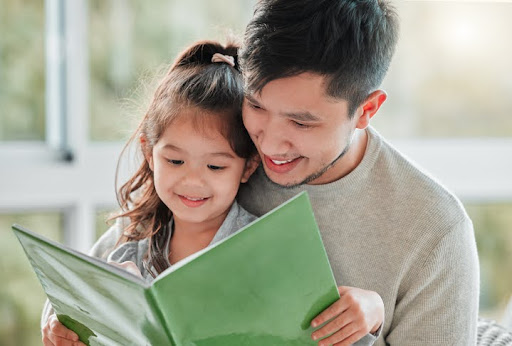
- Bilingual Version: “Chinese Learning – The Seven Chinese Brothers” (Chinese and English Bilingual 2nd Edition) (Teaching Panda Book 8)
- English Version: “The Seven Chinese Brothers” by Margaret Mahy, illustrated by Jean and Mou-Sien Tseng
The Seven Chinese Brothers is a retelling of a classic Chinese folktale where each of the seven brothers has a unique supernatural power. The brothers use their powers to outsmart the emperor and save their youngest brother from execution.
Steps for Parents:
- Introduction to the Book: Briefly explain what the story is about in Chinese to spark interest and provide a context for the story.
- Pre-Reading Discussion: Discuss the cover, title, and illustrations in Chinese. Ask questions like “你觉得每个兄弟的超能力是什么? (What do you think each brother’s power might be?)” and “你觉得他们会怎么用这些超能力? (How do you think they will use these powers?)”
- This is to activate some prior knowledge and stimulate their curiosity.
- Reading Aloud: Read the book aloud in Chinese. Use expressive voices and gestures to make the story fun and engaging.
- Interaction: Pause occasionally to ask comprehension questions and discuss the story to check understanding and encourage critical thinking. For example, “第一个兄弟的超能力是什么?” (What is the first brother’s special power?)”
- Post-Reading Discussion: Discuss the moral of the story and its cultural significance. Ask questions like “为什么合作很重要?” (Why is it important to work together?)
Related Activity Ideas:
- Encourage your child to retell the story in their own words in Chinese. They can use the book as a reference but should try to use their own sentences to reinforce comprehension and language skills.
- Create masks or puppets representing each of the seven brothers. Discuss their unique powers and how they used them in the story in Chinese.
- Prepare a traditional Chinese dish together. Discuss the ingredients and steps in Chinese, linking the activity to the cultural context of the story.
- Have your child draw scenes from the story, focusing on each brother’s unique power. Encourage them to describe their drawings in Chinese.
- Write an alternative ending to the story with your child in Chinese. Discuss how the story might change and what new challenges the brothers could face.
Recommended Books and Publications
Learning the Rules: Chinese Immigrant Parents’ Involvement During Their Children’s Transition to Kindergarten
Authors: Peggy A. Kong, Xinwei Zhang, Anu Sachdev, & Xiaran Yu
Journal Title: Early Childhood Education Journal
Publication Year: 2024
This article examines the beliefs and practices of Chinese immigrant parents regarding their involvement in their children’s transition to kindergarten in the United States. Through interviews with 10 parents in a small Chinese community, it highlights the barriers they face due to limited English proficiency and inadequate knowledge of the American educational system. The study also explores how these parents navigate these challenges by volunteering, comparing educational systems, and building supportive ethnic communities.
This article provides valuable insights into the specific challenges faced by Chinese immigrant families in supporting their children’s education. It offers practical strategies for overcoming language barriers, understanding the American educational system, and building a supportive community. This makes it an essential read for parents in similar situations who wish to enhance their involvement in their children’s early education.
Supporting Bilingualism in Vulnerable Populations
Authors: Maria Vender, Mirta Vernice, & Antonella Sorace
Journal Title: Sustainability
Publication Year: 2021
This article reviews the benefits and challenges of bilingualism, particularly in children with neurodevelopmental disorders such as developmental language disorder, developmental dyslexia, and autism spectrum disorder. The study provides evidence that bilingualism does not exacerbate these conditions but can, in fact, offer cognitive, linguistic, and socio-cultural benefits. The authors discuss the importance of supporting bilingualism in vulnerable populations and offer recommendations for parents, educators, and practitioners on how to provide appropriate linguistic exposure and support.
This article is a valuable resource for parents who are concerned about the impact of bilingualism on children with developmental disorders. It dispels common myths and provides scientific evidence that bilingualism can be beneficial for these children. The practical recommendations included in the article can help parents support their children’s bilingual development effectively.
Home Language and Literacy Practices Among Immigrant Second-Language Learners
Authors: L. Quentin Dixon & Shuai Wu
Journal Title: Language Teaching
Publication Year: 2014
This article examines home language and literacy practices among immigrant children in different countries, drawing on findings from 92 post-2000 studies. It explores how these practices influence literacy development in the societal language and what factors affect their occurrence. The study highlights the benefits of certain practices, such as book reading, and calls for more research into how government policies and community contexts impact literacy development. Additionally, it emphasizes the need for innovative school curricula and family literacy programs that bridge home and school practices and encourage parental involvement.
This article provides valuable insights into the home language and literacy practices that support immigrant children’s literacy development. It highlights the importance of parental involvement and the impact of various factors on children’s learning. The findings and recommendations can help parents understand how to effectively support their children’s literacy in both their home language and the societal language.
Raising A Bilingual Child: A Step-by-Step Guide for Parents
Author: Barbara Zurer Pearson
Publisher: Living Language
Publication Year: 2008
Raising A Bilingual Child provides a comprehensive guide for parents who want to foster bilingualism in their children. The book covers the benefits of bilingualism, the stages of language development, and practical strategies for integrating multiple languages into daily life. Barbara Zurer Pearson offers research-based insights and real-life examples to help parents navigate the challenges and rewards of raising bilingual children.
This book is an invaluable resource for parents aiming to support their children’s bilingual development. It offers step-by-step guidance on how to create a bilingual environment, addresses common concerns, and provides practical tips to make language learning enjoyable and effective. By using this guide, parents can better understand the process of bilingualism and implement strategies that suit their family’s needs.
Bilingual Families: A Practical Language Planning Guide
Author: Eowyn Crisfield
Publisher: Multilingual Matters
Publication Year: 2021
Bilingual Families: A Practical Language Planning Guide offers a comprehensive and accessible approach to creating and implementing a language plan for bilingual families. Eowyn Crisfield provides practical strategies and real-life examples to help parents navigate the complexities of raising bilingual children. The book covers key topics such as language goals, family language policies, and the role of education in bilingual development.
This book is an essential resource for parents who want to actively support their children’s bilingualism. It offers clear, step-by-step guidance on how to develop a personalized language plan, ensuring that parents can make informed decisions that fit their family’s unique needs. The practical advice and strategies presented in the book help create a supportive environment for bilingual development, making it an invaluable tool for any bilingual family.
Foundations of Bilingual Education and Bilingualism (7th Edition)
Author: Colin Baker and Wayne E. Wright
Publisher: Multilingual Matters
Publication Year: 2021
This seventh edition of Foundations of Bilingual Education and Bilingualism provides a comprehensive and modern introduction to bilingual education, bilingualism, and multilingualism. Written from a multidisciplinary perspective, it covers a wide range of topics including individual and societal concepts in minority and majority languages, childhood developmental perspectives, and general bilingual and multilingual education issues. The book also explores bilingual and multilingual classrooms, political and ideological perspectives, and the use of multiple communication systems, among other topics.
Foundations of Bilingual Education and Bilingualism is an invaluable resource for parents who want to support their children’s bilingual development. It offers a thorough understanding of bilingualism and multilingualism, addressing both theoretical and practical aspects. This book helps parents navigate educational systems, understand the importance of bilingualism, and support their children’s language learning effectively.
 East Meets West